Lower limb
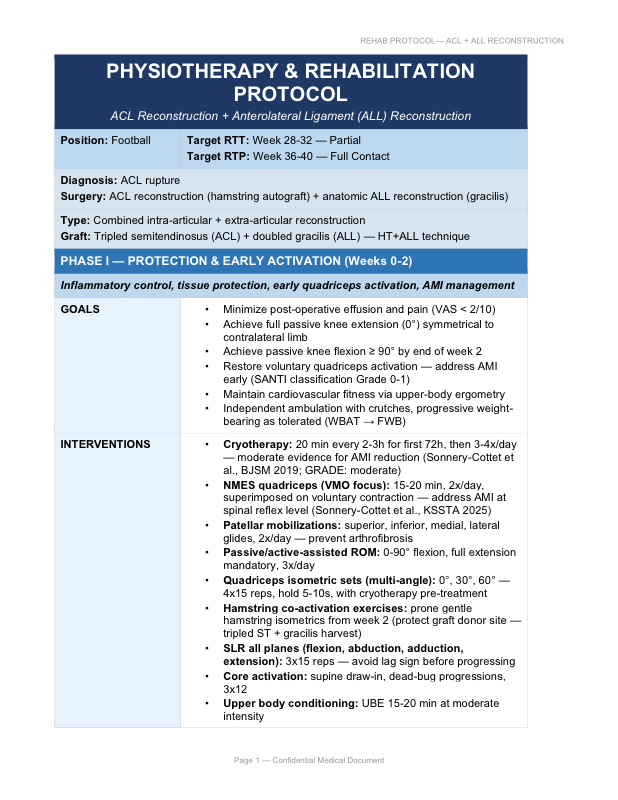
ACL + ALL Reconstruction
Phased rehabilitation for combined ACL + Anterolateral Ligament reconstruction.
Lower limb · Calf — muscular · Elite level
Criteria-based rehabilitation stratified by BAMIC anatomical site. Knee-flexed loading is mandatory; sprint exposure must be completed before return-to-training. Built around Pedret (2015) prognosis data and Lai (2014) sprint biomechanics.
Author and clinical review: Iván López Martínez, sports physiotherapist and rehabilitation specialist.
Content reviewed 15 August 2026. Educational resource for qualified professionals; progression requires individual assessment and clinical judgement. Full references and limitations are included below.
The soleus is the primary ankle work generator in stance-phase locomotion, responsible for roughly 53–74% of ankle positive work via elastic Achilles tendon recoil across speeds of 2–8 m/s (Lai 2014). Its monoarticular architecture, type-I fibre dominance (60–90%), and coupling to the long Achilles tendon define both its central role in running and its specific injury vulnerability.
Soleus injuries in footballers are dominated by cumulative load mechanisms, not single-event explosive tears. They concentrate at five anatomical sites — and the prognosis varies dramatically depending on which one.
| Site | Location | BAMIC suffix | Mean RTP | CIT involved |
|---|---|---|---|---|
| MTL | Proximal lateral myotendinous junction | b | ~19 days | No |
| MTM | Proximal medial myotendinous junction | b | ~25 days | No |
| MFA | Myofascial anterior | a | ~33 days | No |
| MFP | Myofascial posterior | a | ~38 days | No |
| MTC | Central intramuscular tendon (CIT) | c | ~44 days | Yes — worst prognosis |
MTC mean RTP 44.3 ± 23.0 days. CIT injuries follow tendon-grade healing timelines and progress at 1.5–2× slower rate than MTJ injuries.
CIT/MTC injuries require an extended HSR phase (minimum 2 additional weeks) before plyometrics or running re-exposure.
The Rate of Force Development (RFD) — not peak force alone — governs functional capacity at sprint contact times (~100 ms). Late-phase rehabilitation must include explosive intent and stretch-shortening-cycle (SSC) based exercises. A soleus that tests strong on slow isokinetic but lacks RFD will fail the first true sprint exposure.
Includes the complete phase-by-phase prescription, criteria for transition, sprint re-exposure ladder, and CIT-adjustments. Free for qualified health and performance professionals.
With the knee at 30–90°, the gastrocnemii shorten and lose force capacity, making the soleus the primary plantarflexor. Any protocol omitting bent-knee loading under-doses the soleus and leaves a strength gap that re-emerges under sprint demand.
BAMIC (British Athletics Muscle Injury Classification) classifies muscle injuries by anatomical site as "a" (myofascial), "b" (myotendinous junction) and "c" (tendon-associated). For the soleus, central intramuscular tendon (CIT/MTC) injuries (BAMIC-c) carry the worst prognosis — mean RTP ~44 days vs ~19–25 days for MTJ injuries (Pedret 2015).
Elastic energy contribution to ankle work increases from 53% (2 m/s) to 74% (8 m/s) (Lai 2014). Without sprint re-exposure, the storage-release mechanism is undertrained and the athlete is exposed to re-injury when football demands suddenly bring them above their reconditioned ceiling.
Isometric → Isotonic (concentric/eccentric) → Heavy Slow Resistance → Plyometric → Sprint. Each tier builds on the previous one. Isometrics provide tendon stiffness stimulus and cortical analgesia; HSR (65–90% 1RM, 3+3 s tempo, knee-flexed emphasis) is the gold standard for tendon remodelling. CIT/MTC injuries require an extended HSR phase (minimum 2 additional weeks) before plyometrics or running.
Phased rehabilitation for combined ACL + Anterolateral Ligament reconstruction.
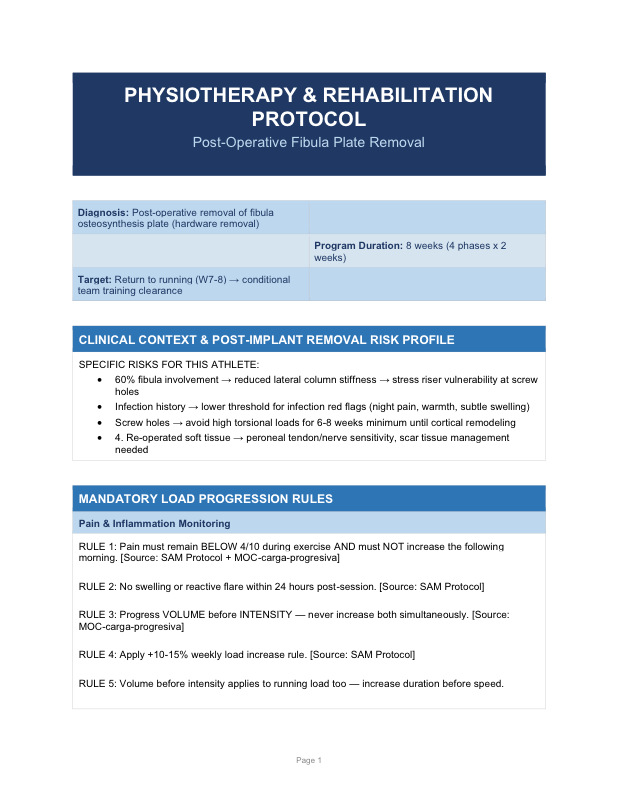
Eight-week rehabilitation in 4 phases of 2 weeks. Return to running W7–8.