Lower limb
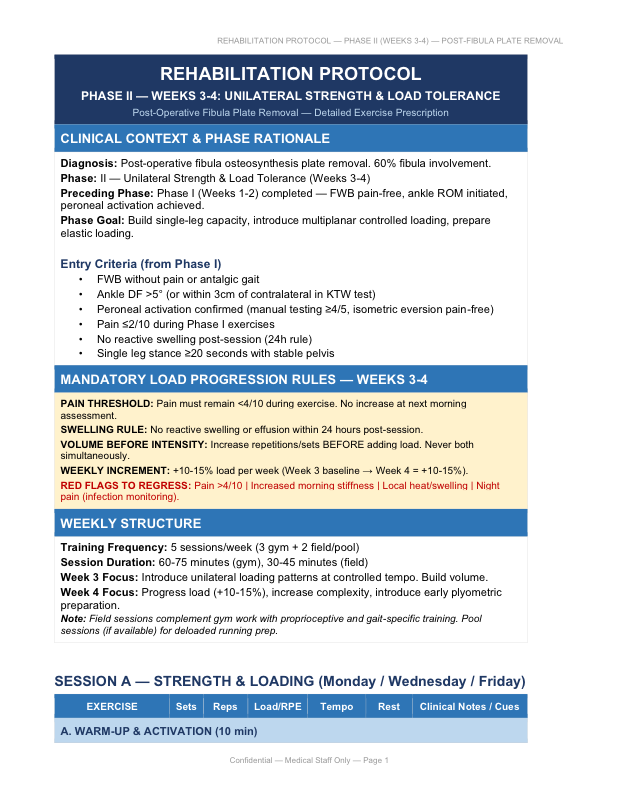
Fibula Plate Removal — Phase II (Weeks 3–4)
Detailed exercise prescription for the unilateral strength and load tolerance phase.
Lower limb · Ankle — post-op · Elite level
An eight-week, four-phase rehabilitation protocol for athletes following fibula osteosynthesis plate removal. Built around explicit load progression rules and infection-specific monitoring, with return-to-running targeted at weeks 7–8.
Author and clinical review: Iván López Martínez, sports physiotherapist and rehabilitation specialist.
Content reviewed 15 August 2026. Educational resource for qualified professionals; progression requires individual assessment and clinical judgement. Full references and limitations are included below.
Hardware removal after fibula osteosynthesis is a deceptively complex rehabilitation case. The bone is no longer instrumented, but each screw hole creates a cortical defect that acts as a stress riser, and re-operated soft tissue (peroneal tendons, scar tissue) requires careful reintroduction of load. With 60% fibula involvement and a prior infection history, the threshold for caution is lower than in a routine post-fixation case.
Every progression in this protocol is governed by five non-negotiable rules:
Wound care, FWB pain-free gait, ankle ROM initiation, peroneal activation, single-leg stance baseline.
Build single-leg capacity, multiplanar controlled loading, prepare for elastic loading. Detailed exercise prescription for this phase →
Progressive plyometric introduction, running mechanics drills, pool-deloaded running if available, controlled change-of-direction at sub-maximal intensity.
Linear running progression (volume → intensity → speed), reintroduction of football-specific actions, conditional clearance for team-training integration once criteria are satisfied.
With 60% fibula involvement, lateral column stiffness is reduced. Cortical bone needs 6–12 weeks to remodel screw-hole defects. The peroneal musculature may be sensitized from re-operation. If syndesmotic screws were part of the original fixation, syndesmotic stability should be reassessed post-removal.
Strictly prohibited in early phases (weeks 1–4): high-speed cutting or change of direction, maximal jumping, contact training, single-leg landings from height.
The complete protocol contains every phase with exercise prescription, progression criteria, and red-flag rules. Free for qualified health and performance professionals.
Each removed screw leaves a cortical defect (a "screw hole") that acts as a stress riser. Cortical bone requires 6–12 weeks to remodel these defects, and high torsional loads should be avoided during that window. With 60% fibula involvement, lateral column stiffness is meaningfully reduced until remodelling completes.
The protocol targets return to running between weeks 7 and 8, conditional on satisfying the load-tolerance and pain criteria of phases I–III. Volume is progressed before intensity — duration before speed. Conditional team-training clearance follows once running is consolidated.
Pain >4/10 during exercise (reduce load 30%), increased morning stiffness vs. baseline, local warmth or swelling (stop loading 24–48 h), and night pain at the surgical site (stop all loading and seek medical review immediately — earliest indicator of infection). With prior infection history, the threshold to escalate is lower.
Cutting and sudden change of direction generate high torsional loads through the lateral column. Until cortical remodelling of the screw holes is complete (6–8 weeks minimum), these movements concentrate stress at the holes and risk re-fracture.
Detailed exercise prescription for the unilateral strength and load tolerance phase.
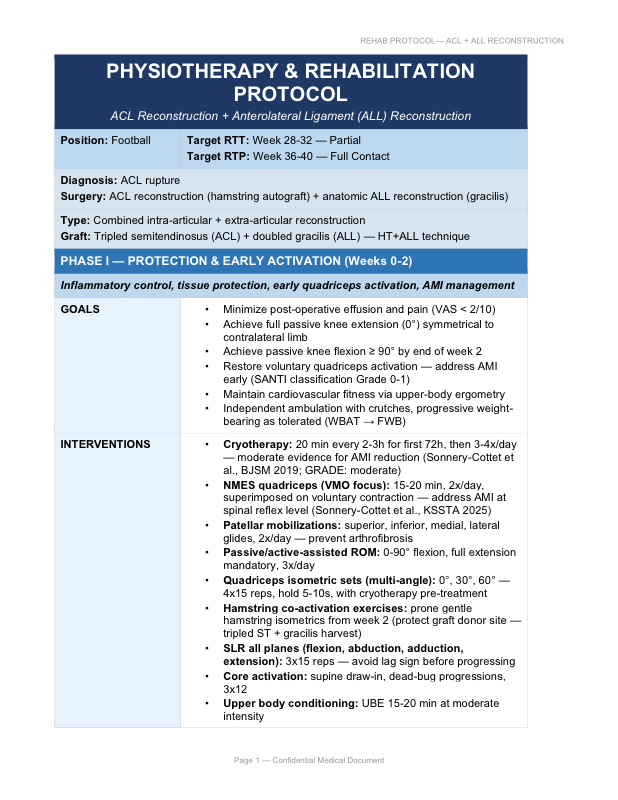
Phased rehabilitation for combined ACL + Anterolateral Ligament reconstruction. RTP W36–40.