Lower limb
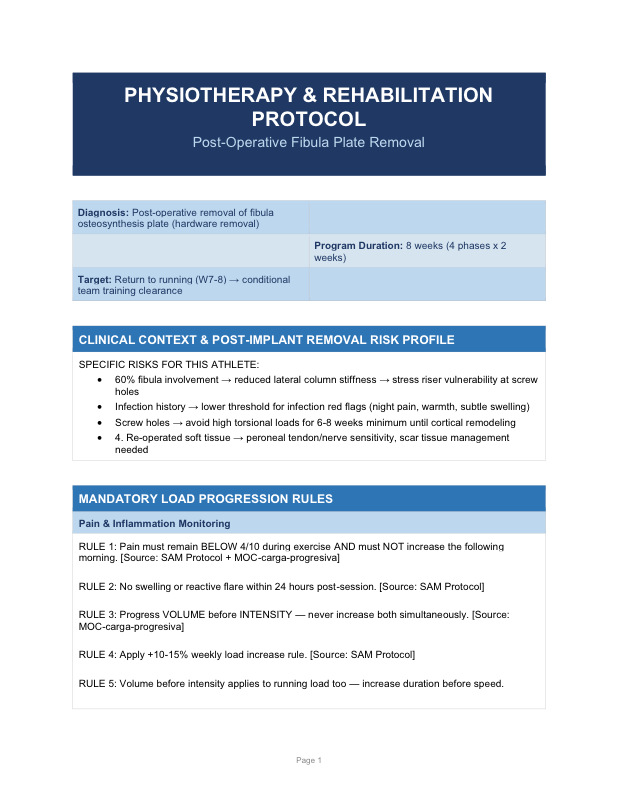
Post-Operative Fibula Plate Removal — Full Program
Eight-week rehabilitation in 4 phases of 2 weeks. Return to running W7–8.
Lower limb · Ankle — post-op · Elite level
Detailed exercise prescription for the unilateral strength and load-tolerance phase of the post-fibula plate removal program. Sets, reps, tempo, RPE and clinical cues — built for high-performance football environments.
Author and clinical review: Iván López Martínez, sports physiotherapist and rehabilitation specialist.
Content reviewed 15 August 2026. Educational resource for qualified professionals; progression requires individual assessment and clinical judgement. Full references and limitations are included below.
Training frequency: 5 sessions/week — 3 gym (Mon / Wed / Fri) + 2 field or pool (Tue / Thu).
Field sessions complement gym work with proprioceptive and gait-specific training. Pool sessions (when available) prepare deloaded running.
Each gym session opens with a 10-minute warm-up & activation block (stationary bike, ankle controlled articular rotations, banded eversion isometric holds, arch-doming activation), followed by the unilateral loading block: split-squat variations, step-ups, calf-raise variants in both knee-extended and knee-flexed positions, controlled lateral and rotational loading patterns, and accessory work for the kinetic chain.
The full session plan with sets, reps, load/RPE, tempo, rest periods and clinical cues for every exercise is provided in the downloadable PDF.
Field sessions reintroduce gait-specific demand at sub-running intensity: marching variations, controlled lunges in multiple planes, single-leg stance progressions on stable and unstable surfaces, low-amplitude landings from a step. Pool sessions (when available) reintroduce running mechanics in a deloaded environment as preparation for Phase III running progression.
Includes the complete Mon/Wed/Fri and Tue/Thu session plans with sets, reps, tempo, RPE, rest, and clinical cues for every exercise. Free for qualified health and performance professionals.
Full weight-bearing without pain or antalgic gait, ankle dorsiflexion >5° (or within 3 cm of contralateral on Knee-To-Wall), confirmed peroneal activation (manual ≥4/5, isometric eversion pain-free), pain ≤2/10 during Phase I exercises, no reactive swelling within 24 h, and single-leg stance ≥20 s with stable pelvis.
Doubling the stimulus is the fastest route to flare-ups. Volume before intensity is a load-management principle that protects post-operative tissue: progress sets and reps first, then add load. The +10–15% weekly cap further insures against overshoot.
After every loading session, swelling and morning stiffness are checked the next morning. If either has increased above baseline, the previous session was too much — load is reduced and the next session adjusted. The 24-hour signal is more reliable than in-session feedback for post-operative tissue.
Five sessions per week: three gym sessions (Mon/Wed/Fri, 60–75 min) focused on strength and loading, plus two field or pool sessions (Tue/Thu, 30–45 min) for proprioceptive and gait-specific training, or deloaded running preparation.
Eight-week rehabilitation in 4 phases of 2 weeks. Return to running W7–8.
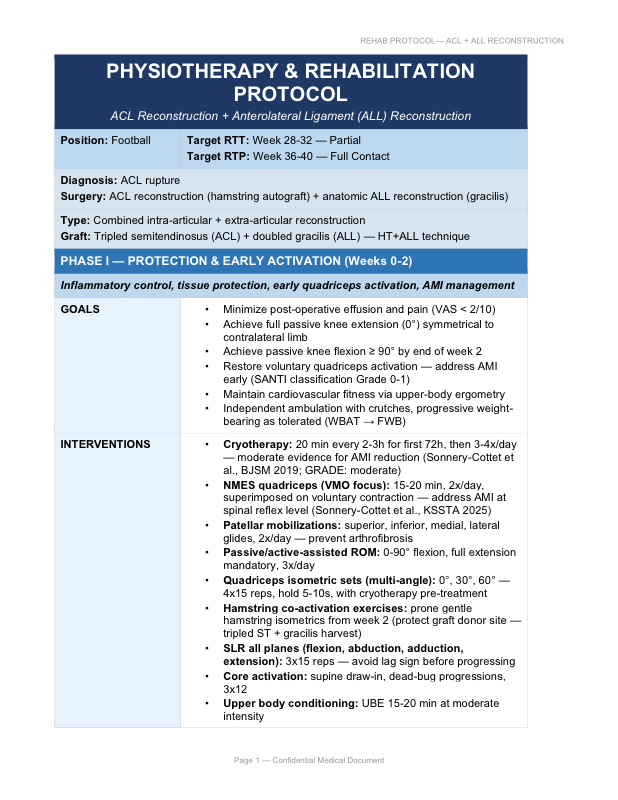
Phased rehabilitation for combined ACL + Anterolateral Ligament reconstruction.